REACHING NEW LEVELS OF STUDENT SUCCESS
BY BRITNEY ZINT ORANGE COUNTY CATHOLIC
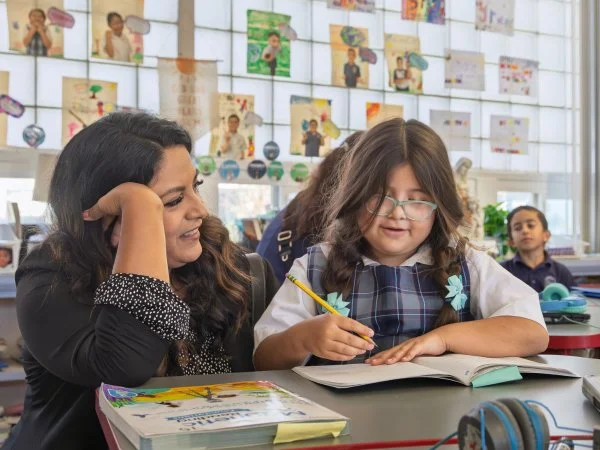
CLAUDIA GARCIA, PAX CHRISTI ACADEMIES VICE PRESIDENT OF ACADEMIC EXCELLENCE AND LEADERSHIP VISITS WITH ST. ANN PARISH SCHOOL STUDENT ELLA CEJA DURING HER CLASS' STATIONS ROTATION. PHOTO BY ALAN WENDELL/DIOCESE OF ORANGE
IMPLEMENTING A NEW TEACHING MODEL, innovative educational technology and constant cross-campus collaboration are helping a network of Orange County Catholic schools reach new levels of student success.
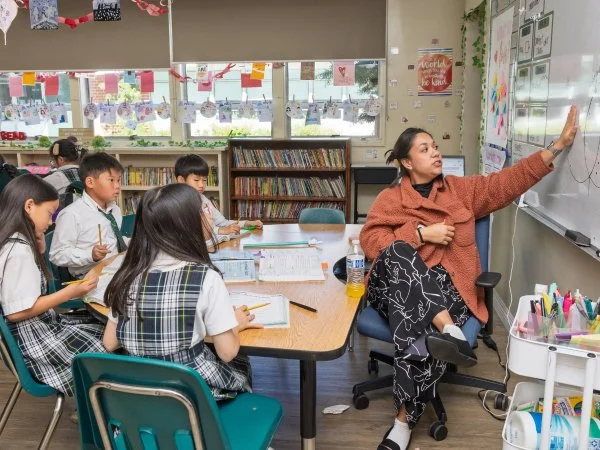
ST. BARBARA CATHOLIC SCHOOL STUDENTS ENGAGE IN A SMALL GROUP LEARNING STATION LED BY THIRD-GRADE TEACHER ALICIA PAYAN. PHOTOS BY ALAN WENDELL/DIOCESE OF ORANGE
Leadership of Pax Christi Academies — comprising St. Barbara, La Purísima, St. Anne, St. Joseph (Santa Ana) and St. Justin Martyr schools — is pointing to these factors as evidence that the once-struggling schools can rise above. Since the start of this school year, 144 students in reading and 192 in math have moved from below grade level, to at or above grade level, according to student test data.
“When we first visited our schools, we recognized an opportunity to approach things differently,” said Claudia Garcia, vice president of academic excellence and leadership. “Our students deserve an experience that inspires their learning and growth.”
Key to that success, achieved in under two years of concerted effort, is the implementation of the Station Rotations teaching model. This strategy prioritizes instruction where students need it most, breaking the student body down to flexible groups of those who need extra support, are right on target or are ahead and ready for enrichment. Students’ levels are measured by using i-Ready, a computer program that provides individualized learning and progress assessments. Teachers receive i-Ready’s data each week so they can address each student’s unique needs and make lesson plans accordingly.
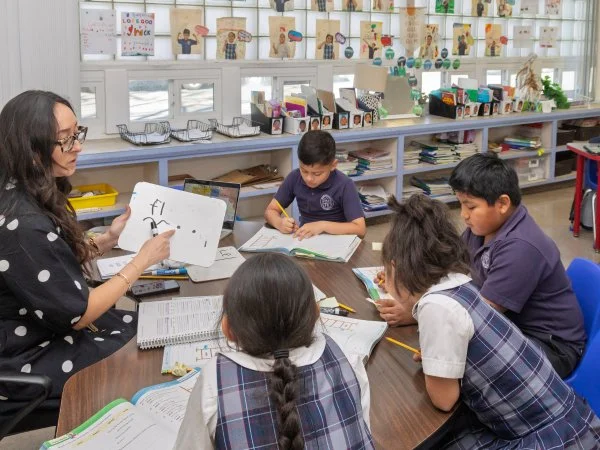
ST. ANNE PARISH SCHOOL’S KARINA HERNANDEZ TEACHES PHONICS TO HER SECOND-GRADE STUDENTS AT A LEARNING STATION.
“They have the work that will meet them where they are,” said St. Barbara Catholic School Principal Claudia Danzer. “Once they take that diagnostic, it gives them their own path, and they are able to work on those skills and fill in those gaps that might be missing along the way.”
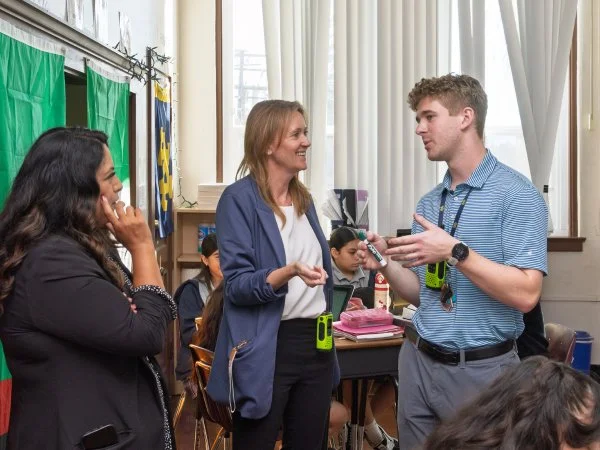
CLAUDIA GARCIA, PAX CHRISTI ACADEMIES VICE PRESIDENT OF ACADEMIC EXCELLENCE AND LEADERSHIP, AND ALLISON ESSMAN, PRINCIPAL OF ST. ANNE PARISH SCHOOL, DISCUSS THE STATION ROTATION PROGRAM WITH BRENDAN MCKEEGAN, A ST. ANNE’S SEVENTH-GRADE TEACHER.
Pax Christi Academies — a shared governance established in July 2024 with the intent of fixing declining enrollment — is seeing the approach has created an environment that honors each student’s dignity.
“When we look at our students, we see each one as a unique creation of God,” said Garcia, “and they come to us with different gifts. When they work in Station Rotations, we’re allowing them to be who they are.”
In addition to Station Rotations, the five Pax Christi schools work more collaboratively, standardizing their math, English language arts and Catholic virtue curriculums. Each site now has the same materials and training. In effect, they collaborate and speak the same language, according to St. Anne Parish School Principal Allison Essman.
“That’s the beauty of Pax Christi: They provide what is needed, what is essential, what these kids deserve,” she said.
INSIDE THE CLASSROOM
In every Pax Christi Academies school, Station Rotations happen twice a day: one for reading and one for math. Each classroom utilizes at least three rotations: small group instruction, tech rotation and collaborative rotations. A typical Station Rotation is in Mrs. Hernandez’s second-grade classroom at St. Anne’s, where she is not in front of the classroom and students are not sitting in rows at desks. Some are on the carpet, the teacher’s table or at a desk. Hernandez is at a back table teaching a small group. Some students are sitting at desks working on “super words” — the most common words students will encounter in reading, but which don’t follow typical spelling patterns.
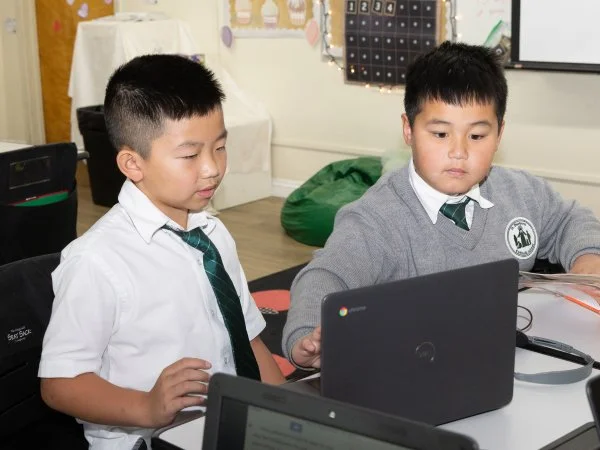
NATHAN HOANG RECEIVES HELP FROM MARTIN NGUYEN DURING A ROTATION STATION ACTIVITY AT ST. BARBARA CATHOLIC SCHOOL.it stand out
The freedom to work independently, or with a peer, is what St. Anne’s seventh-grader Sheila Perez likes. She said Station Rotations make learning more interesting by granting her movement and independence. She also feels more comfortable asking questions in small groups.
“I think it’s pretty cool because we get to work on our own stuff and then we can also do teamwork,” Perez said. Independence, collaboration and movement are big for all students. Even in Brittany Yezzo’s kindergarten class at St. Anne’s, the students get the same freedom to work independently and collaboratively.
Across Santa Ana to St. Barbara Catholic School, the same strategy is being utilized. In Alicia Payan’s third-grade classroom, her advanced students sit with her for small-group time.
Third-grader Jacob Benitez, 9, said he likes Station Rotations because he enjoys working and helping his friends. His favorite part is that he is working ahead in math on i-Ready.
“What I like about i-Ready is it teaches me higher stuff and makes me smarter, so when the teacher teaches our class, I already know it,” Benitez said.
WHY IT WORKS
Station Rotations, combined with weekly data, flexible groupings and targeted teacher small groups, is giving Pax Christi Academies its desired student growth, which isn’t just something talked about between adults, but regularly with each student. Teachers are holding data chats to discuss progress.
Essman and Danzer both said they have seen a change on campus as students feel more in control and have taken ownership of their learning.
“It takes learning from being this thing that the adults oversee to: ‘I’m taking responsibility and I have control over how well I do the next time,’” Danzer said.
In addition to the formal assessment data collected in i-Ready, the small groups allow teachers to collect more informal data. For Hernandez, she has seen the smaller setting allow her shy students to open up and show her what they know. That information is informing and changing what will be taught, said Brendan McKeegan.
“I think it offers an opportunity to work a little more closely with each individual learner so you can kind of operate in a sense of: What does this one individual child, individual soul, need to grow closer in becoming a better version of themselves,” McKeegan said.
At the end of this school year, Pax Christi will have data to see how everything is paying off.
“We’d love to see all of our students show growth and attain grade-level proficiency,” Garcia said, “so that they could go on to the high school of their choice, go on to university and really go out and do great things and live virtuous lives.”